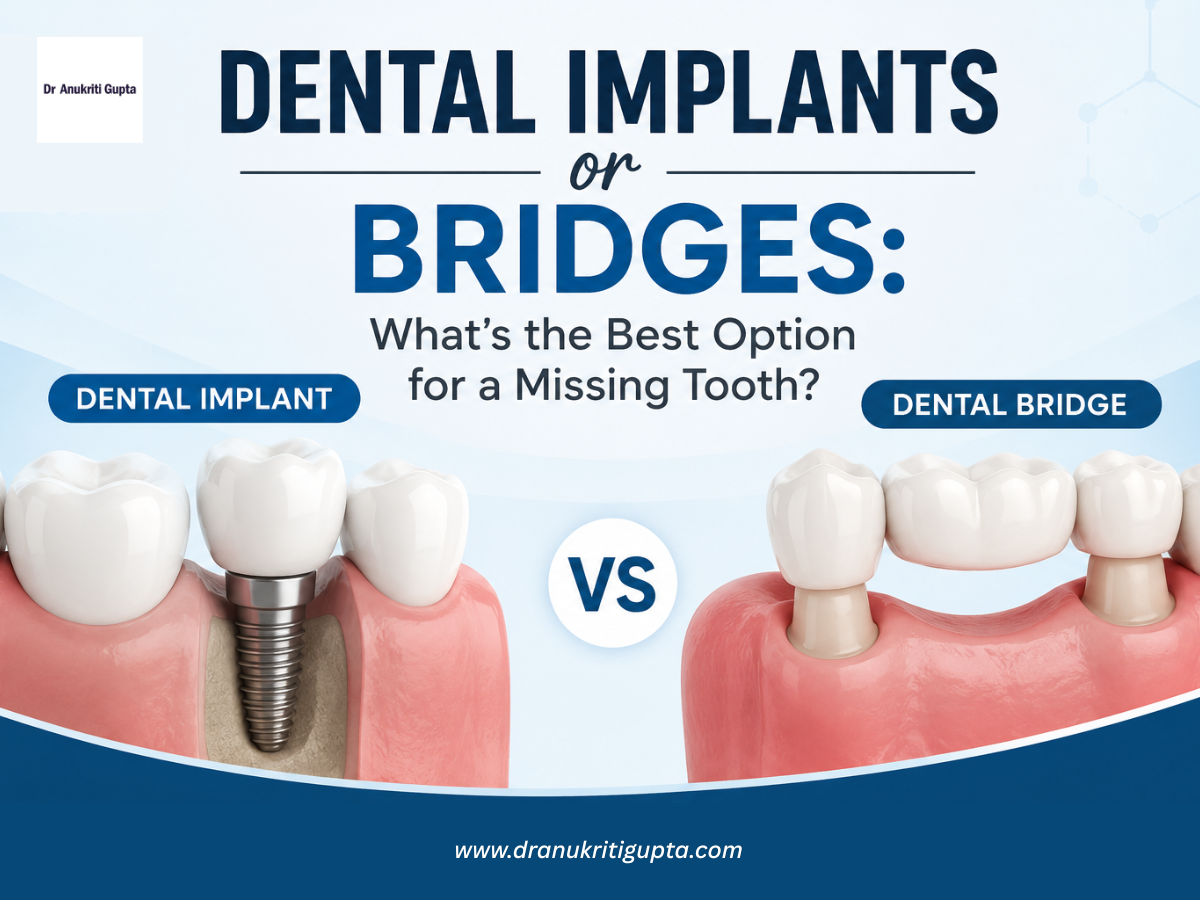
Losing a tooth, whether from decay, an accident, or age, changes more than your smile. It affects how you chew, how you speak, and eventually, the shape of your jaw if the gap is left untreated. Once you’ve decided to replace it, the next question is almost always the same: implant or bridge? Both work. Both look natural once placed. But they solve the problem in very different ways, and the right choice depends on your bone health, budget, and how long you want the solution to last. This blog compares the two honestly, so you can walk into your dental consultation already informed. For most healthy adults with adequate jawbone density, a dental implant is the stronger long-term choice because it preserves bone and can last a lifetime. A bridge is a faster, less invasive option and works well when adjacent teeth already need crowns or when implant surgery isn’t suitable. The right answer depends on your bone health, timeline, and budget, not a one-size-fits-all rule. A dental implant replaces the entire tooth, root included. A titanium or zirconia post is placed directly into the jawbone, where it fuses with the bone over a few months through a process called osseointegration. Once healed, a custom crown is attached on top. Because the implant acts like a real tooth root, it keeps stimulating the jawbone every time you bite or chew. This is the biggest advantage implants have over almost any other option: they prevent the bone loss that naturally follows a missing tooth. A bridge takes a different route. Instead of replacing the root, it replaces only the visible tooth. The two healthy teeth on either side of the gap are shaped down and fitted with crowns, which anchor an artificial tooth, called a pontic, in between. There’s no surgery involved, and the treatment timeline is shorter, usually completed in two to three visits over a couple of weeks. But because the bridge sits on the gum rather than in the bone, it doesn’t stop the underlying bone from gradually shrinking over time. Neither option is universally “better.” A bridge can be the smarter choice for someone who already needs crowns on the adjacent teeth, has limited healing time, or isn’t a candidate for implant surgery due to bone loss or certain health conditions. An implant makes more sense for someone who wants to avoid touching healthy teeth and is looking for the most durable, long-term fix. This is the part that gets skipped in most online comparisons. With a bridge, the two teeth next to the gap are permanently altered, ground down to hold the crowns. Even if those teeth are perfectly healthy, they now carry extra load and depend on the bridge staying intact. If one of those anchor teeth ever develops decay or needs a root canal, the entire bridge may need to be redone. An implant doesn’t touch neighbouring teeth at all. It stands independently in the jawbone. This is one reason prosthodontists often lean toward implants when the surrounding teeth are healthy and bone quality is good. Implants aren’t automatically the best option for everyone. If you have low bone density, uncontrolled diabetes, or you smoke heavily, healing around an implant can be unpredictable, and a bridge may be the safer route. Cost and timeline matter too. If you need a functional tooth quickly and can’t commit to a multi-month process, a bridge fills that gap faster. This is exactly why a proper evaluation, including X-rays and a bone density check, should always come before deciding. Many patients researching solutions for common dental issues like tooth loss and decay assume implants are always superior, but the right choice genuinely depends on individual mouth conditions. Choosing between a dental implant and a dental bridge isn’t something to decide from an article alone; it needs a clinical assessment. With our dentistry for adults services, Dr. Anukriti Gupta carefully evaluates before recommending either option, so you’re not guessing. This ensures you receive a solution tailored to your needs, not a one-size-fits-all recommendation. Book a consultation at either of our dental clinics in Gurgaon, conveniently located at Elan Miracle Mall, Sector 84, and Satya The Hive, Sector 102, to receive a clear and personalised recommendation instead of a generic one. If you’d like to hear how other patients felt about their crown, bridge, or implant treatment before making a decision, our patient testimonials page has real, unfiltered experiences worth reading. Missing teeth rarely get better on their own, and delaying treatment can lead to bone loss, shifting teeth, and more complex dental problems. Schedule your consultation with Dr. Anukriti Gupta today and find out which option actually fits your mouth, not just your search results. Implants involve minor surgery, so initial healing takes longer, but modern techniques make the procedure largely painless. Bridges avoid surgery entirely, causing only mild sensitivity while the anchor teeth are shaped. Implants typically last 15 to 25 years or longer with good care. Bridges usually last 8 to 15 years before needing replacement, since the anchor teeth and cement bear ongoing wear. Sometimes. Bone grafting can rebuild enough density for an implant in many cases. Your dentist will check this with an X-ray before recommending an implant or suggesting a bridge instead. Yes, bridges usually cost less upfront since there’s no surgery or healing period involved. Implants cost more initially but often prove more economical over time due to their longer lifespan. Only a clinical evaluation, including X-rays and a gum and bone assessment, can confirm this. Book a consultation so your dentist can recommend the option suited to your specific mouth. Dental implants or bridges for a missing tooth: what should you actually choose? A direct answer
How a dental implant works
How a dental bridge works
Comparing the two side by side: Dental Implant vs Dental Bridge
Factor
Dental Implant
Dental Bridge
Treatment time
3–6 months (includes healing)
2–3 weeks
Involves surgery
Yes
No
Affects neighbouring teeth
No
Yes, they’re reshaped
Bone preservation
Yes
No
Average lifespan
15–25+ years with care
8–15 years
Upfront cost
Higher
Lower
What most patients don’t consider: the neighbouring teeth
When a bridge is genuinely the right call
Getting the right diagnosis first
Frequently Asked Questions
Q1. Are dental implants more painful than bridges?
Q2. Which lasts longer, an implant or a bridge?
Q3. Can I get an implant if I’ve lost bone in my jaw?
Q4. Is a bridge cheaper than an implant?
Q5. How do I know which option is right for me?